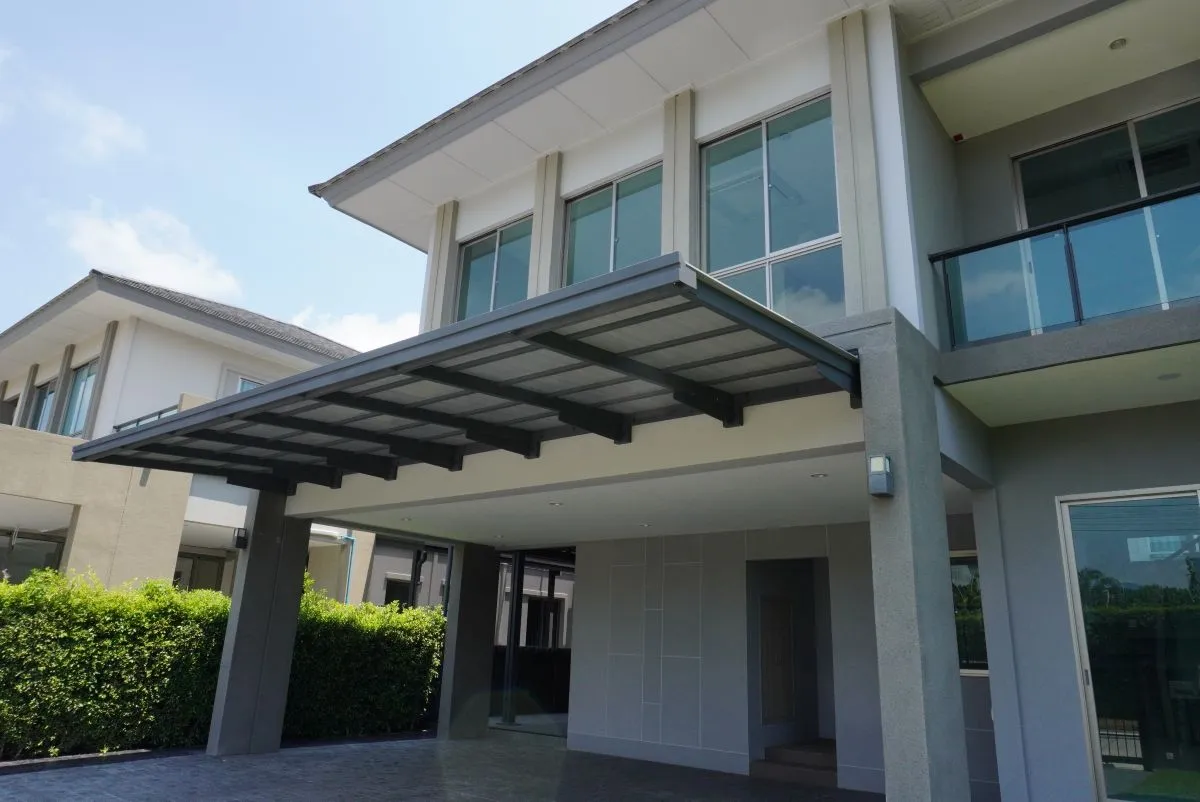
Key takeaways
Installing a front awning on a south-facing house is the most effective way to lower the temperature inside, because the south takes the southern-arc sun almost all year round, so walls and glass build up a lot of heat. Choosing a material that reflects infrared, such as Shinkolite acrylic in the Heat Cut model, or vinyl sheet with low thermal conductivity, directly reduces the load on the air conditioning. A precisely designed projection and pitch also shades the whole window area in the afternoon, when heat is at its peak, turning the front of the house into a relaxation corner usable all year round
Many people choose a south-facing house hoping for good breezes through the year, but end up with sun shining into the house all day. In Thailand the sun arcs to the south for about 8-9 months, so the walls and glazing on this side build up enormous heat. An awning on a south-facing house is therefore one of the barriers that stops heat before it enters the home
Understanding the nature of a south-facing house
A south-facing house is known as the most comfortable orientation. If shading is handled with a south-facing front awning at the right angle, it is breezy and cool. Here is what homeowners should know
- Southern-arc sun (September-April): This is when the sun arcs to the south. Sunlight strikes at a high vertical angle, unlike the west, where the sun hits the house head-on. Although southern sun does not shine straight into the windows in the afternoon as much as western sun, heat keeps building up and reflecting into the house
- Northern-arc sun (May-August): The sunlight shifts to the north, so the front of a south-facing house gets enough light without being very hot. This is the rest period for a house on this orientation
- The hottest period (January-April): The sun is at its furthest south and gradually moves up, until mid-April, when it is directly over Thailand, so in this period the south takes the most heat energy and is at its most stifling of the year
Tips for reducing heat with an awning for the south side
Now that we know how the sun behaves in Thailand, the next question many people raise is what kind of roof a south-facing house should have, or what kind ofawningis suitable and worth the long-term investment
Choose materials that focus on heat protection
The first factor to consider in a roof or awning is the roofing material, which directly affects the temperature of the space beneath. For a south-facing house we recommend considering these 2 types of roofing
- Heat Cut translucent sheet: For homes that want brightness so the front does not look dark, but want to block heat, we recommendShinkolite acrylic in the Heat Cut model, or premium-grade Solid Polycarbonate sheet. These materials have infrared-reflecting additives in the sheet and lower the temperature better than ordinary sheets
- Opaque materials: Vinyl sheet is a material well suited to south-facing front awnings, because it is a uPVC material with low thermal conductivity and internal air gaps that act as heat insulation, and it also absorbs sound extremely well when it rains
Designing the pitch and projection
Besides the choice of material, the design of the awning's angle and projection is just as important
- Set the pitch in relation to the direction of the southern-arc sun: Installing an awning on a south-facing house requires precise calculation of the pitch and the height on the wall. If it is mounted high, the projection must be extended further, so the roof's shadow falls just right over the windows
- Leave a gap at the wall for ventilation: We recommend designing a front awning with a gap between the roof and the building wall at a suitable point. This lets the hot air that builds up under the awning flow out upwards, in line with aerodynamic principles

Other ways to boost heat reduction
Besides an awning for a south-facing house, there are other techniques that help keep the home cool and comfortable, as follows
- Plant trees to filter the light: Planting tall trees with fine foliage in front of the awning reduces the force of the sunlight and filters hot wind into cool breeze before it enters the house
- Choose the structure colour: Choose a light colour for the awning structure, such as white, cream or light grey, to reduce the heat the steel absorbs from the sun and make the front of the house look more open
Make a south-facing house cool and comfortable with ROOVTECT's premium awning service
Do not let the heat of the sun spoil the restful atmosphere of your home. Let ROOVTECT design and build afront awningmade specifically for south-facing houses. We specialise in extensions to high standards of craftsmanship
- Heat Defense Technology: We select only materials with industrial-grade heat-protection technology, for proven temperature reduction
- Customized Engineering: Our team calculates the projection and pitch to suit the position of each house and its sun direction, to make sure the awning shades as much as possible
- Seamless Design: Design focused on beauty and modernity, in keeping with the existing architecture, with meticulous installation and no bulky joints
Turn a sweltering south-facing house into a cool, comfortable place to relax. For advice on installing an awning on a south-facing house, visit the website ROOVTECT or call: 02-096-3464 and LINE OA: @roovtect and book a visit to see the real materials atour showroomtoday
References
Know before you build: how to lay out a house for the right sun, wind and rain direction. Retrieved 30 March 2026 from baanlaesuan.com
Frequently asked questions about south-facing front awnings (FAQs)
Q: How long should the awning (projection) on a south-facing house be at minimum to shade well?
A: To block the southern-arc sun, a suitable projection is usually 1.5-2.5 metres, depending on the height of the windows and the mounting height of the awning. If the windows are very tall, the projection needs to be increased so the awning's shadow reaches the bottom edge of the window between 2 pm and 4 pm
Q: Will an opaque awning make the front of the house so dark that lights are needed in the daytime?
A: Designed correctly, it will not make the house too dark, because natural light can still reflect from the floor below or the gaps around it into the house. If you are worried about darkness, you can choose high-quality translucent material that blocks heat, or add Skylight panels at some points
Q: Does a permanent awning affect ventilation or the breeze that should blow into a south-facing house?
A: If it is fitted tight against the wall with no ventilation gap, heat may build up under the roof. With ROOVTECT's design system, we calculate the sheet spacing and height so the breeze still flows into the house as normal
Q: How do the lifespans of vinyl and acrylic awnings differ on a side with strong sun like the south?
A: Both materials are premium grade with a lifespan of more than 10 years. Shinkolite acrylic stands out for its beautiful clarity and colour stability, while vinyl stands out for heat protection and quietness. It depends mainly on the homeowner's taste and use