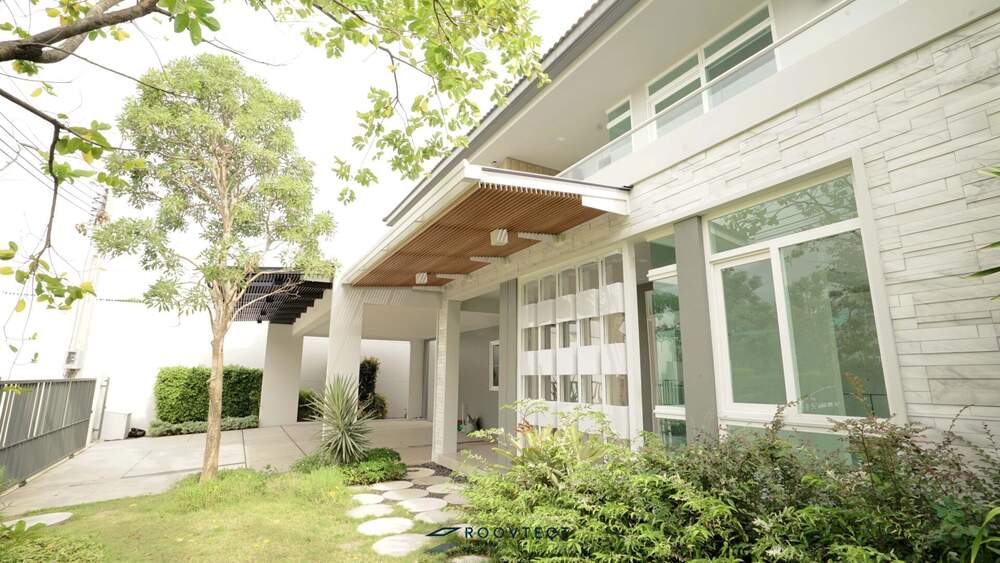
Whether you have bought a new estate home or lived in the same house for years, one thing many people face is a ‘home extension’. An estate home may not have space that perfectly suits your family, and a house you have lived in for years may need updating for a growing family. But did you know that even when extending on your own land, you must study home extension law carefully and proceed correctly, to avoid problems later?
Summary of home extension law you should know
Before starting, many people will ask, ‘Do I need a permit for a home extension?’ The answer is that some do and some do not, because Thailand has clear law on roof and house extensions under the Building Control Act B.E. 2522 (1979), Sections 21 and 39 bis, which comes down to 5 key points
1. An extended building must leave at least 30% open space
Whatever the size of your land, if youwant to extend your home, you must leave at least 30% open space between the house or building and the land boundary, so that in an emergency such as fire, collapse or earthquake there is room to escape and officials can get in to help. A building up to 15 metres high must have at least 1 metre of space around it, and over 15 metres, 2 metres
2. Setbacks must follow the law
Home extension law sets out setbacks as follows
- A fence or wall built closer to a public road than its own height may be no more than 3 metres high measured from the footpath or public road level
- For a building or house over 9 metres but under 23 metres high, walls, openings and balconies must be 3 metres from the land boundary
- For a building or house up to 9 metres high, walls and openings must be at least 2 metres from the land boundary, or at least 0.5 metres for a solid wall
3. Engineers and architects must supervise the work
Extension plans must be certified by an engineer and architect before construction can go ahead. If materials are changed, an engineer must calculate whether it is safe before building. Besides following the law, this adds safety during the work and in future use
4. Permission from officials is required first
Some types of home extension need permission from local officials, namely
- Extensions over 5 square metres
- Changes to the number of columns or beams
- Extensions that change materials and dimensions
- Extensions that add to the weight of the house
5. Consent from neighbours
Finally, even though it is your own home, you also need your neighbours' consent. By law a solid wall can be built at least 0.5 metres from a neighbour's land. Get consent in writing to prevent disputes later

Steps for getting a home extension permit
Under the law described above, any homeowner whose extension needs official permission can follow these simple steps
- Contact the authority responsible for the area where the house is, to submit a building permit application. In Bangkok, contact the district office; in other provinces, the local administrative organisation
- Once the application to build, modify or demolish is approved, collect the permits: the notice of issue of a building permit and the building permit
- Build according to the plans. Building differently from the approved plans is punishable by up to 3 months in prison, a fine of up to 60,000 THB, or both
Home extensions you can do without a permit
Besides extensions that need a permit, for those who would rather not deal with the authorities, some types of extension can go ahead directly, in these 5 cases
- Adding or reducing the floor area of any one storey by no more than 5 square metres
- Adding or reducing roof area by no more than 5 square metres
- Changing the building structure using materials of the same size, number and type as the original
- Changing other parts inside the house not related to the building structure
- Adding floor area in the house not related to the building structure
Now that you know whether a home extension needs a permit, if you are planning aroof extension, awning extension orCarport Roof Installation at good value and built to last, choose ROOVTECT Full-service roof installation, from design and structure to completed installation, with every step handled by professional architects and engineers. 5-year structural warranty and 2-year component warranty. For more information Call 02-096-3464 or LINE Official Account: @roovtect
References
- Home extension law you need to know to prevent damage and breaking the law. Retrieved 17 July 2024 from https://hba-th.org/บ้านน่ารู้/home-improvement-laws
- 5 home extension cases that need no district office permit. Retrieved 17 July 2024 from https://www.ddproperty.com/คู่มือซื้อขาย/ต่อเติมบ้าน-5-เคสที่ไม่ต้องขออนุญาต-7394